ERV vs Dehumidifier vs Fresh Air Dehumidifier: Which System Fits Your Project?
News |
11/7/2026 4:46:21 AMAn ERV, a standalone dehumidifier and a fresh air dehumidifier solve different parts of an indoor-air project. A conventional ERV exchanges outdoor and exhaust air while recovering energy. A standalone dehumidifier removes moisture from recirculated room air. A fresh air dehumidifier combines an outdoor-air provision with active moisture removal; its exact air paths and other functions depend on the model.
The useful buying question is not which label is best. It is whether the building needs more controlled outdoor air, more water removal, or both. Establish those two duties separately before comparing equipment.
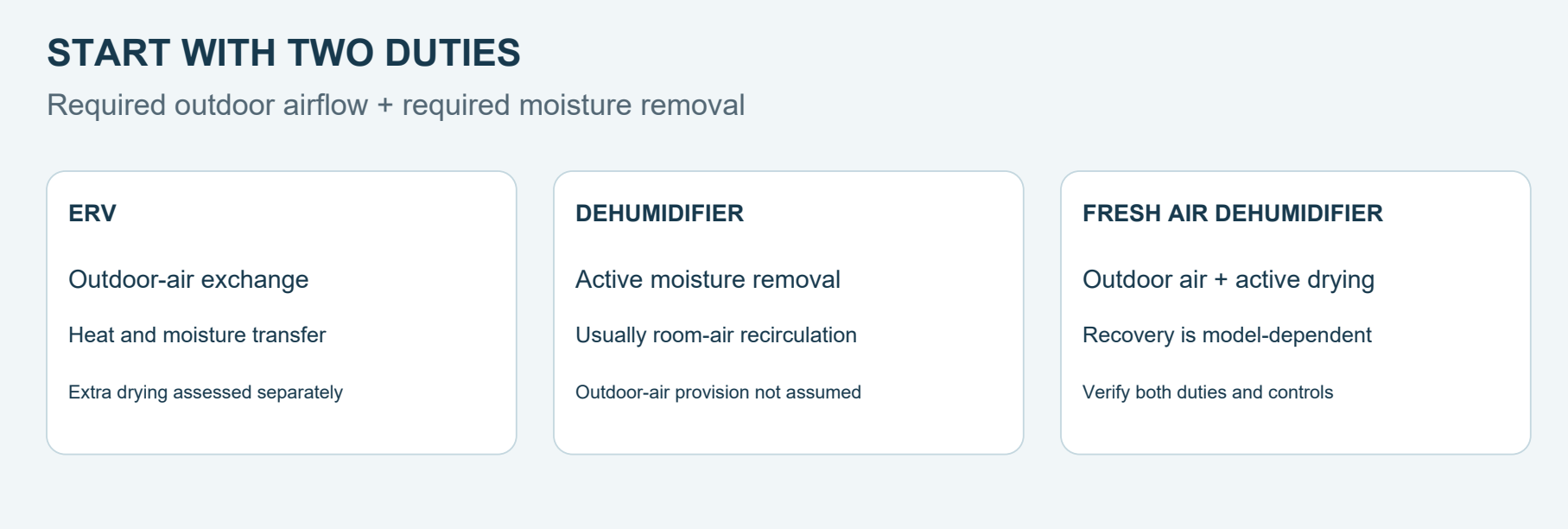 Concept comparison of functions, not an installation drawing or performance test.
What an ERV does and what it does not establish
An energy recovery ventilator transfers heat and some water vapor between incoming and outgoing air streams [1]. That exchange can reduce a ventilation load. It does not make a conventional passive ERV equivalent to a compressor-based dehumidifier, nor does a recovery-efficiency figure establish the room humidity it will maintain.
For an ERV vs dehumidifier comparison, ask for the outdoor airflow at the intended duct resistance and the recovery performance at the design conditions. If the project also needs active moisture removal, assess that load separately. Some equipment combines functions; confirm what is actually included rather than transferring features from another model.
Compare the three system arrangements
| Selection question |
ERV |
Standalone dehumidifier |
Fresh air dehumidifier |
| Outdoor-air duty |
Core ventilation function |
Not assumed for a recirculating unit |
Confirm the stated outdoor-air rate |
| Active water removal |
Not established by passive recovery alone |
Core function |
Confirm capacity at design conditions |
| Energy recovery |
Core documented function |
Not implied by the label |
Model-dependent; verify |
| Common fit to assess |
Ventilation with energy recovery |
Local or distributed moisture removal |
Combined ventilation and moisture duty |
| Main installation checks |
Supply/exhaust paths; balancing; filters |
Room distribution; drainage; service |
Air paths; drainage; controls; service |
Three examples that lead to different selections
A room already has adequate ventilation but remains damp. A standalone dehumidifier may address a local moisture problem. Confirm room-air circulation, operating temperature and water disposal. Portable and ducted whole-home dehumidifiers are different arrangements [2]; a portable unit in one room does not establish uniform control throughout a divided building.
A building needs controlled outdoor air, with no demonstrated extra moisture-removal load. Evaluate an ERV against the required ventilation, climate and duct duty. Record indoor conditions instead of adding a dehumidification function solely because the outdoor relative-humidity reading looks high.
A humid-climate project needs ventilation and supplemental moisture control. Compare an ERV plus separate dehumidification with a suitably specified fresh-air dehumidifier. PNNL describes separate and integrated arrangements, including units connected to an outdoor-air intake [3]. Neither arrangement wins automatically: review air distribution, controls and service access for the actual project.
These are selection examples, not complete designs or promises that a named model fits a particular floor area. Repair leaks and investigate damp materials independently; equipment selection does not replace moisture-source correction [4].
Request comparable performance evidence
Ask each supplier to state outdoor-air flow separately from total or recirculated airflow, the available airflow at the external static pressure, and the moisture-removal capacity at the proposed entering-air temperature and humidity. Keep the rating conditions visible beside every L/day value. A daily rating is not guaranteed output in a cooler or drier building.
Compare energy data only with compatible test conditions and equipment scope. Dehumidifier integrated energy factor is expressed as water removed per unit of electricity [2]. Do not substitute nameplate watts, ERV recovery efficiency or an assumed running schedule for a verified annual-cost comparison.
Check condensate routing, permitted lift where a pump is included, maintenance access and the control sequence. Ask what happens when humidity demand remains after cooling demand falls, and how the selected arrangement maintains its ventilation duty. Installation details and safeguards must come from current model instructions.
Questions buyers often ask
Can an ERV replace every dehumidifier? No. Recovery and active water removal are separate functions. Determine whether supplemental capacity is needed from the design conditions and measured building behavior.
Does a standalone dehumidifier bring in outdoor air? A recirculating unit should not be assumed to do so. Some ducted products support a designed outdoor-air connection; confirm that configuration explicitly [3].
Is a fresh air dehumidifier always the cheaper option? No general cost conclusion is justified. Compare the installed scope, ductwork, controls, service requirements and condition-matched performance.
Prepare a project selection request
For an integrated product example, review the DECETOMair AQCS configuration and our humid-building selection guide. Use the survey and handover checklist to organize installation questions. Send the project country, building use, outdoor airflow requirement, design temperature and humidity, and installation or drain constraints through the existing contact page. Ask for a condition-matched proposal; the product page is not evidence of project suitability.
Sources
[1] US DOE Building Science Education: HVAC Energy Recovery Ventilation
[2] ENERGY STAR: Dehumidifiers
[3] PNNL Building America Solution Center: Whole-House Dehumidification
[4] US EPA: A Brief Guide to Mold, Moisture and Your Home