Fresh Air Dehumidifier Selection for Humid Buildings
News |
10/23/2026 2:05:49 AMDECETOMair ventilation guide
 AI-generated concept scene illustrating the article topic, not a documented installation or performance result.
A fresh air dehumidifier or an ERV with dehumidification should be assessed against both outdoor-air demand and moisture-removal load.
A humid building can need outdoor air and active moisture removal at the same time. An energy recovery ventilator transfers energy between air streams, while a dehumidification function removes water from air. These tasks should be sized separately. The DECETOMair AQCS series combines fresh-air ventilation, energy recovery and dehumidification in a ducted product intended for project evaluation; its model selection must consider both ventilation demand and moisture load.
The term ventilating dehumidifier is used for equipment that combines outdoor-air provision with active moisture removal. It does not establish that every product has the same heat exchanger, duct arrangement or control sequence. Compare those details before treating two systems as substitutes.
Humid climate ventilation and the moisture load
Outdoor air may contain more or less moisture than indoor air. Relative humidity alone cannot establish which air stream is drier because temperature also changes the reading. A designer should compare moisture content or dew point and account for indoor moisture generation before deciding how ventilation affects the building's moisture balance.
An ERV can transfer some water vapor as well as heat, depending on its exchanger, but this is different from removing water as condensate [1]. In a humid climate, energy recovery does not by itself prove that a project humidity target will be met. Conversely, reducing ventilation simply to avoid moisture can conflict with the required outdoor-air provision.
AQCS as an ERV with dehumidification
The August 2026 DECETOMair Chinese central fresh-air sheet identifies AQCS as an integrated dehumidifying fresh-air ERV. It lists AQCS-60 at 450 m3/h with 60 L/day dehumidification capacity, and AQCS-80 at 550 m3/h with 80 L/day capacity [3]. The current product table states a dehumidification rating condition of 30°C and 80% RH. These are published manufacturer figures, not a guarantee of water removal under every room condition.
The same source lists a DC variable-speed motor, smart controller, pre-filter and H12 high-efficiency filtration arrangement, PM2.5, VOC, temperature and humidity sensors, a condensate lift pump and app control. A filter class describes the filter specification; it should not be converted into a whole-room removal percentage or a certification claim without the relevant evidence.
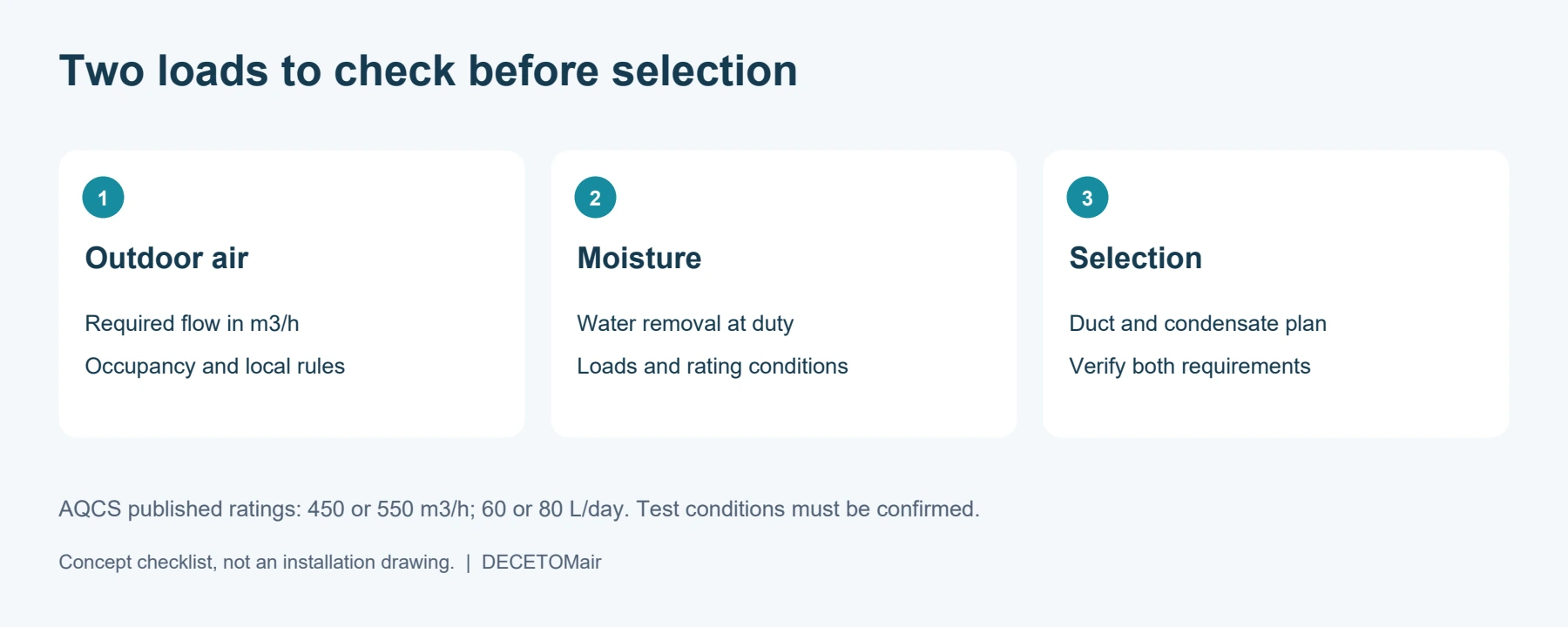 Selection diagram separating required outdoor airflow in m3 per hour from moisture-removal load and checking both at the design conditions. Concept checklist, not an installation drawing.
Size ventilation and dehumidification separately
Start with occupancy, room use and the local outdoor-air requirement. Then establish the moisture load from outdoor ventilation air, infiltration, occupants and activities. Water leaks and damp construction materials need their own correction. EPA's moisture guidance emphasizes fixing water problems and managing indoor moisture rather than relying on a single appliance [2].
For comparison, 60 L/day divided by 24 is 2.5 L/h and 80 L/day divided by 24 is approximately 3.33 L/h. These are arithmetic averages of published daily ratings, not verified hourly operating capacities. Before selecting either model, request the dehumidification test temperature, humidity, operating mode and performance at the intended entering-air conditions.
A design with an estimated 2 L/h moisture load, for example, is not automatically covered by a 60 L/day label. The operating conditions, run time and control sequence may differ from those used to obtain the rating. Use a condition-matched performance selection and allow for the actual application rather than assuming the division proves adequacy.
Check airflow against the duct system
The sheet lists maximum static pressures of 230 Pa for AQCS-60 and 260 Pa for AQCS-80. Maximum pressure and maximum airflow should not be assumed to occur together. Ask for fan curves or an actual duty-point selection that accounts for ducts, terminals, filters and accessories.
Confirm dimensions, port sizes and the installation drawing for the exact delivered model. Published dimensional sources differ, so this guide does not use them as installation dimensions. Provide service space as well as physical clearance: a unit that fits above a ceiling still needs a way to remove filters, access the drain system and inspect the equipment. The installation drawing must determine port positions and air connections; do not guess them from a marketing image.
Include condensate and controls in the proposal
The listed lift pump does not eliminate drainage design. Confirm allowable lift, drain routing, inspection access, protection against leakage and the appropriate control response to a drain fault. Request the approved installation instructions rather than inferring a universal arrangement.
Define how ventilation, dehumidification and the building's cooling system will operate together. Ask for supply-air temperature information and a clear sequence for periods when humidity demand remains but sensible cooling demand is low. The rated electrical figures, 780 W for AQCS-60 and 870 W for AQCS-80, are not annual energy-use predictions.
Frequently asked questions
Is a whole house dehumidifier with fresh air the same as AQCS
A whole house dehumidifier with fresh air may address similar needs, but the ventilation arrangement, energy recovery, airflow and moisture capacity must be compared. Ask the ERV supplier for a project selection, duct duty point and rating conditions before deciding.
Does AQCS make oxygen
No oxygen-generation function is established by the reviewed data. The fresh-air function supplies outdoor air; it should not be advertised as oxygen production or medical oxygen enrichment.
Does 60 or 80 mean heat recovery efficiency
No. In the model-specific Chinese table these figures are dehumidification capacities in L/day. They must not be published as 60% or 80% heat-recovery efficiencies.
Is it a replacement for every air conditioner
No such replacement claim is supported. Cooling load, supply-air conditions and controls must be evaluated as part of the overall HVAC system.
Prepare a project selection request
Send DECETOMair the site climate, floor plan, design indoor conditions, outdoor-air requirement, moisture-load estimate, available static pressure and drain constraints. Request a model-specific selection with the rating conditions and maintenance clearances stated explicitly.
Review the current AQCS-60 / AQCS-80 product configuration, our ventilation survey and handover checklist, or contact DECETOMair for a project selection.
Sources
[1] US Department of Energy HVAC Energy Recovery Ventilation. Source
[2] US EPA A Brief Guide to Mold Moisture and Your Home. Source
[3] DECETOMair Chinese central fresh-air specification sheet August 2026 rows 15 to 17. Manufacturer specification.