Fresh Air Humidification for Dry Season Ventilation
News |
11/2/2026 2:37:45 AM AI-generated concept scene illustrating the article topic, not a documented installation or performance result.
Fresh air humidification combines outdoor-air provision with moisture addition when a dry-season building needs both.
In a dry-season building, outdoor-air ventilation and moisture addition can need to operate together. A fresh-air humidification unit combines those functions, but the correct size depends on both the required airflow and the moisture deficit. The DECETOMair ABJS series is an option to evaluate for this task. It should be selected from project conditions rather than floor area or a model number alone.
Ventilation with humidification should be selected as a coordinated air and moisture system. A ducted humidifier arrangement needs attention to airflow, water requirements and service access, while the indoor moisture target must respect the building envelope.
Winter humidity control in a ventilated building
Cold outdoor air can have a high relative humidity while containing little water vapor. Once that air is heated indoors without adding moisture, its relative humidity falls. The design question is therefore how much moisture the ventilation and infiltration air need at the indoor target temperature, allowing for moisture already generated inside.
Adding humidity is not always appropriate. A building may already have damp surfaces or condensation at windows and thermal bridges. EPA's residential guidance recommends keeping indoor humidity below 60%, ideally 30% to 50%, but this is general guidance, not a universal humidifier setpoint [1]. The building envelope, outdoor temperature and application should determine a safe operating target.
What the ABJS series is documented to provide
The August 2026 DECETOMair central fresh-air specification identifies ABJS as a fresh-air ventilation and humidification unit. ABJS-300 is listed at 300 m3/h and 2 kg/h humidification capacity; ABJS-400 is listed at 400 m3/h and 2.5 kg/h [2]. Both list medium-efficiency filtration, an LCD controller and humidity-sensor-based adjustment.
The reviewed data do not establish heat recovery, dehumidification, HEPA filtration, app control or a particular water-treatment technology for ABJS. A proposal should use the documented functions and request clarification on any additional requirement. Features of AQCS or other DECETOMair products should not be carried across to this series.
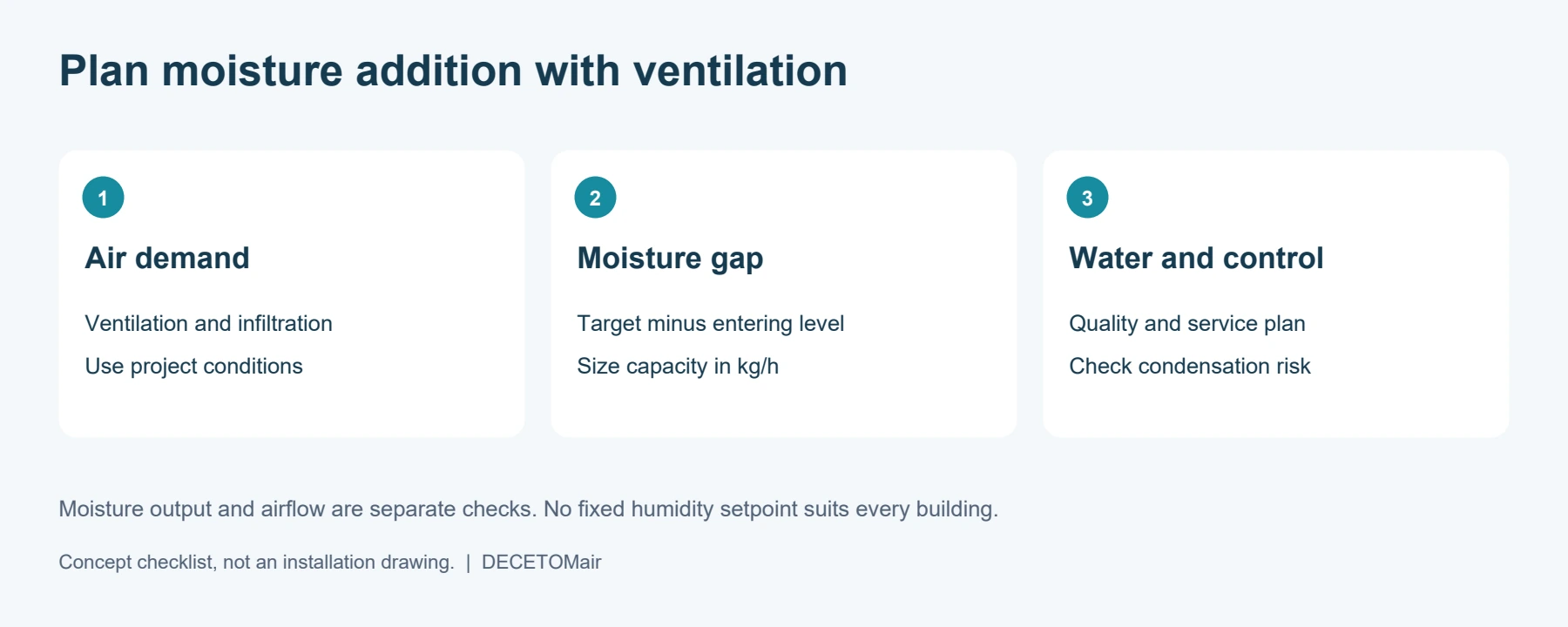 Humidification selection checklist connecting outdoor airflow, moisture deficit, water service and condensation control. Concept checklist, not an installation drawing.
Calculate humidification capacity from the moisture deficit
A preliminary moisture balance relates dry-air mass flow to the difference between target and entering humidity ratios. In simplified form, moisture addition in kg/h equals dry-air mass flow in kg/h multiplied by the humidity-ratio increase in kg water per kg dry air. A full design also considers infiltration, internal sources, operating hours and the chosen system arrangement.
For illustration only, assume an air stream of 300 m3/h, an approximate air density of 1.2 kg/m3 and a required humidity-ratio increase of 0.004 kg/kg. Multiplying 300 by 1.2 by 0.004 gives approximately 1.44 kg/h. This is a screening calculation with simplified density, not a certified ABJS operating point or a universal winter design load.
The example does not prove that ABJS-300 will deliver 2 kg/h under the proposed conditions. Request the rated entering-air conditions, water requirements, usable modulation range and available capacity at the specified duty. The system must also be able to reduce output as the moisture deficit falls; maximum output alone is not a control strategy.
Ducted humidifier airflow and service checks
Published maximum static pressures are 180 Pa for ABJS-300 and 200 Pa for ABJS-400. Do not assume that those maxima coincide with the listed 300 or 400 m3/h airflow. Ask for a fan curve or a selection at the actual resistance of the duct and terminal system.
Confirm the installation orientation, access side and the space needed to service the humidity-control components. Obtain the current model-specific dimensions and drawing before designing the ceiling opening. Port labels and positions should come from that drawing, not an assumed airflow sketch.
Resolve water and hygiene requirements before ordering
Ask how water is supplied, what water quality is permitted, how the unit is drained or cleaned and which consumables require replacement. The reviewed parameter sheet does not specify the humidification method, so a supplier's answer and installation instructions are necessary before designing those connections.
The controls should address loss of airflow, excessive humidity and any water-related fault as required by the actual system design. Ask which safeguards are included and which are external responsibilities. Maintenance access, isolation arrangements and a written service plan should be included in the project scope rather than left to the end of installation.
Commission to conditions inside the building
Measure room humidity at representative occupied locations and compare it with the controller reading. Inspect windows and other cold surfaces while operating in the intended season. If condensation appears, investigate the moisture target and envelope conditions rather than increasing humidity to chase a fixed number.
The sheet lists electrical ratings of 100 W for ABJS-300 and 150 W for ABJS-400. These are published product ratings, not a guaranteed whole-system annual consumption or proof of a particular humidification mechanism. Confirm the electrical schedule and any ancillary equipment with the final selection.
Frequently asked questions
Is ABJS the same as a whole house humidifier
Whole house humidifier is a broad category, including units that rely on other HVAC equipment. ABJS is documented as a fresh-air ventilation and humidification unit. Ask a fresh air humidifier supplier to confirm the actual arrangement, capacity conditions and water system.
Does ABJS remove moisture in summer
Dehumidification is not documented in the reviewed ABJS sheet. A humid-season project needs a separately assessed moisture-removal solution.
Are 2 and 2.5 heat recovery percentages
No. They are humidification capacities in kg/h in the Chinese model-specific table. They must not be advertised as heat-exchange efficiencies.
Can I use one humidity target throughout winter
Not automatically. The target must respect the building's cold surfaces, outdoor conditions and application. Check actual performance and condensation during commissioning.
Request an ABJS project proposal
Send DECETOMair the location, design outdoor conditions, indoor temperature and humidity targets, ventilation airflow, duct resistance and available water and drainage arrangements. Request a capacity selection and a written explanation of the water system, controls and maintenance requirements before ordering.
Review the current ABJS product configuration and the ventilation survey and handover checklist, or contact DECETOMair with your project requirements.
Sources
[1] US EPA A Brief Guide to Mold Moisture and Your Home. Source
[2] DECETOMair Chinese central fresh-air specification sheet August 2026 rows 20 to 22. Manufacturer specification.