 AI-generated concept scene, not a documented customer installation.
Single room heat recovery ventilation is a room-level approach to providing outdoor air during a home retrofit.
A single room heat recovery ventilator can add controlled outdoor air to a bedroom, study or living area without installing a central duct network. The DECETOMair ABT701 series through-wall HRV is an option for this type of retrofit. Selection should start with the room and its occupants, then check the airflow delivered in the intended operating mode. A model name or maximum airflow alone cannot establish whether one unit is sufficient.
For this application, a ductless HRV means a local through-wall unit rather than a central indoor duct network. Buyers may also encounter the term single room MVHR, meaning mechanical ventilation with heat recovery. Those category terms do not establish identical airflow, controls or test performance between products.
Bedroom ventilation when windows stay closed
A home may feel stuffy when windows remain closed for weather, noise or security. Adding a portable air purifier addresses a different task from providing outdoor air. A ventilation plan must identify how fresh air enters, how indoor air leaves and how air moves through the occupied room. EPA describes source control, ventilation and filtration as complementary indoor-air strategies [1].
A through-wall unit can be worth evaluating where there is an accessible exterior wall and a central duct retrofit would be disruptive. It still needs a suitable wall opening, electrical connection, weather protection and maintenance access. An interior room without a workable outdoor connection needs a different design.
How a single room HRV uses a ceramic core
In its alternating heat-recovery cycle, the ventilator extracts indoor air through a ceramic core and then reverses direction to supply outdoor air through the same core. The ceramic material stores and releases heat between these phases. Supply-only and exhaust-only modes serve different operating purposes; continuous one-direction operation does not provide the same alternating heat-recovery process.
One alternating unit does not supply and exhaust simultaneously. If a project needs coordinated operation between rooms or units, obtain the current wiring and control instructions rather than assuming synchronization is included. Room transfer paths and other exhaust appliances must be considered during design.
ABT701 and ABT701-WF model differences
The manufacturer's published specification lists both ABT701 and ABT701-WF at 50 m³/h, with an EC motor, ceramic core, primary filter, four fan speeds, sleep mode and wireless remote control. The WF version additionally lists Tuya Smart app control and VOC and humidity sensing for smart operation [3]. App control and those sensors should not be described as standard features of the basic ABT701.
The standard primary filter provides basic filtration and should not be presented as a HEPA system. Neither the product name nor the presence of a sensor establishes particle-removal efficiency, gas-removal performance or a medical benefit. Choose any supplementary air cleaner according to its own documented performance.
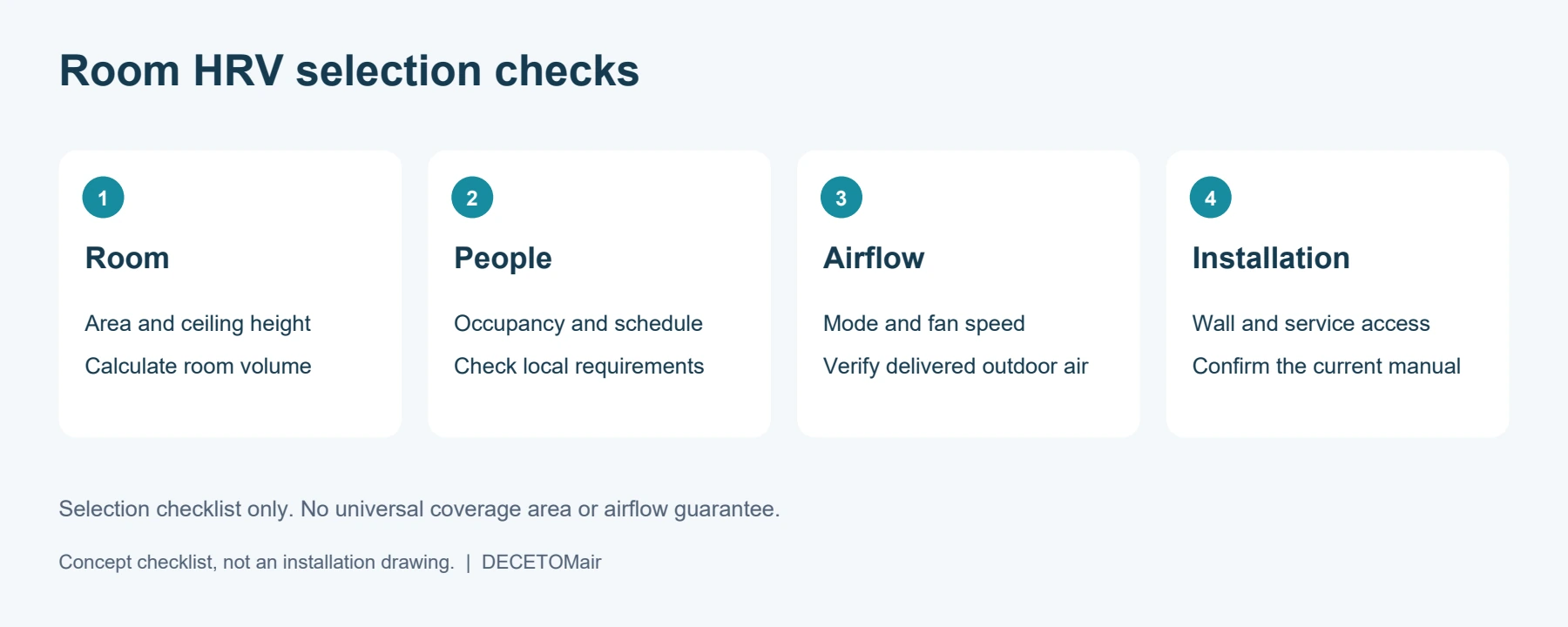 Room volume, occupancy, operating airflow and installation access all affect selection. Concept checklist, not an installation drawing.
Size the room before selecting the unit
Begin with room volume: floor area multiplied by ceiling height. For an illustrative room of 20 m² with a 2.5 m ceiling, the volume is 50 m³. Dividing a hypothetical continuous outdoor-air supply of 50 m³/h by that volume gives 1 air change per hour. This arithmetic is a screening example, not the effective outdoor-air delivery of one ABT701 operating in alternating mode.
The published 50 m³/h figure must be checked against fan speed, operating mode, test conditions and the installed pressure conditions. Confirm whether the rated figure represents one-direction airflow or a defined cycle-average value before using it for project sizing. Do not turn it into a universal room-area claim. The applicable local ventilation requirement and occupancy calculation should determine the design target.
For the wider project calculation, read our guide to sizing an ERV or HRV system for a residential project.
Through wall ventilation installation checks
For a bedroom, ask for acoustic data at the airflow needed overnight, including measurement distance and test method. A sleep-mode label does not prove that the remaining airflow meets the room requirement. Keep the indoor terminal clear of curtains and furniture and avoid directing the airflow onto the bed.
Ask the installer to verify wall thickness, the supplied sleeve, the specified opening, exterior clearances, rain protection and sealing. Confirm combustion-air and pressure interactions where fuel-burning appliances are present. A room ventilator should not be assumed to replace a cooker hood or a bathroom extraction system.
Keep access for routine maintenance
Allow enough space to remove and inspect the filter and ceramic core. Follow the current component-specific cleaning instructions, disconnect power before servicing and reinstall washable filters only when fully dry. Inspect sooner if visible dust builds up; a calendar reminder should not override the observed condition.
Frequently asked questions
What should I ask an HRV supplier before a bedroom retrofit?
Ask your HRV supplier for airflow at the intended operating mode and speed, acoustic test conditions, wall-opening requirements and maintenance access. HVAC distributors and installers should confirm the exact ABT701 or ABT701-WF configuration.
Can one ABT701 ventilate a whole apartment?
It is a room-level product. A whole-apartment proposal needs a layout, occupancy, airflow targets and transfer-air plan; a single published capacity does not prove whole-home coverage.
Does the WF version measure carbon dioxide?
The standard ABT701-WF configuration lists VOC and humidity sensing, not CO2 sensing. Other configurations must be checked separately; CO2 monitoring should not be advertised as a standard ABT701-WF feature.
Does heat recovery replace heating or air conditioning?
No. Heat recovery preconditions incoming air using heat from the extraction phase. It is not an independent room heating or cooling system [2].
Discuss your home ventilation project
Compare the ABT701 and ABT701-WF product specifications and controls, then send DECETOMair your project requirements: room dimensions, occupancy, climate, wall thickness, electrical supply and preferred controls. Request the current technical sheet and mode-specific airflow information so the proposal matches the actual room.
Sources
[1] US EPA Improving Indoor Air Quality.
[2] US Department of Energy HVAC Energy Recovery Ventilation.
[3] DECETOMair ABT701 series published product parameters. Confirm the current model configuration and installation instructions for the project.