ERV vs HRV: Which Is Better for Humid, Cold and Mixed Climates?
News |
9/1/2026 1:29:45 AMA practical guide for distributors, HVAC contractors and project buyers.
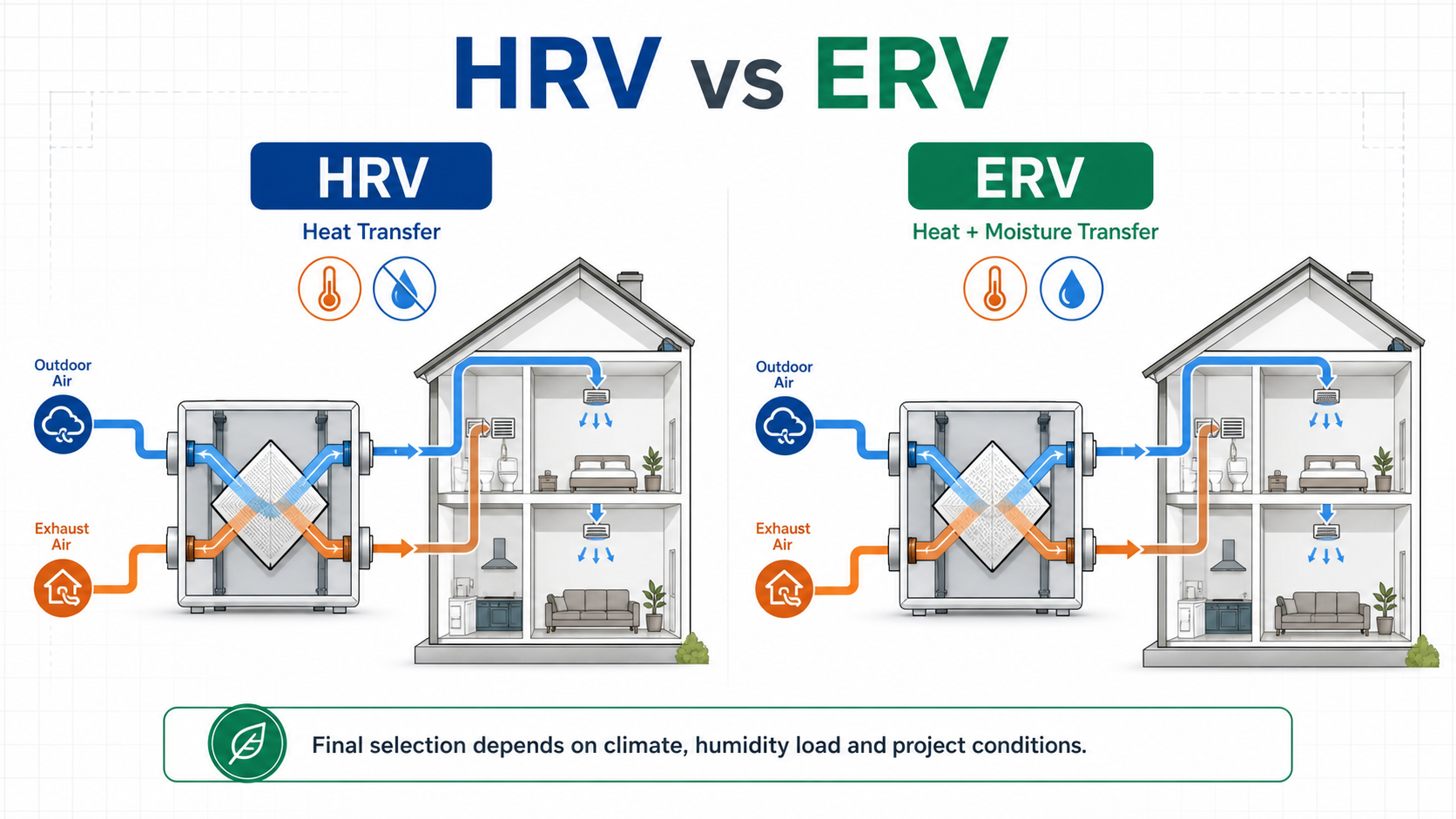
The short answer
HRVs and ERVs perform the same basic job: they exhaust stale indoor air, bring in outdoor air and recover energy between the two airstreams. The practical difference is moisture transfer. An HRV primarily recovers sensible heat, while an ERV also transfers part of the moisture load through its exchange core.
For a hot-humid project, we would normally evaluate an ERV first because moisture transfer can reduce the latent load created by outdoor ventilation air. In a cold-dry climate, the decision turns on the building's moisture balance: some projects need to remove indoor humidity, while others benefit from retaining more of it. Mixed climates require both summer and winter checks. The climate label alone is not enough to select the unit.
Important: an ERV is not a dedicated dehumidifier
An ERV can reduce the moisture load introduced by ventilation air, but it cannot guarantee a project-specific indoor relative-humidity setpoint. Buildings in hot-humid regions may still require correctly sized cooling equipment or dedicated dehumidification. ERV or HRV selection should therefore be part of the whole-building moisture calculation, not a substitute for it.
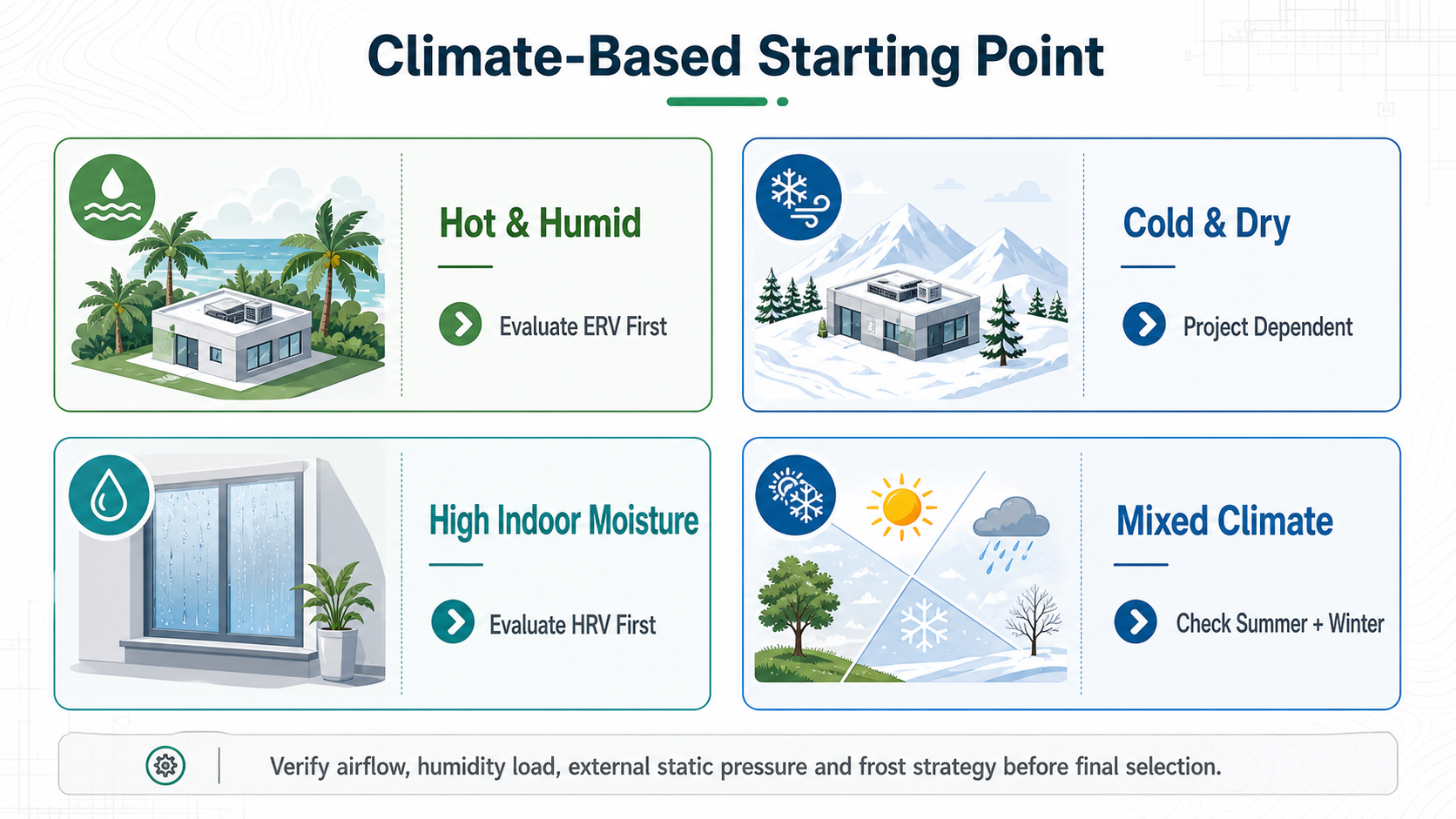
Seven project factors that matter more than the label
- Required outdoor airflow. Calculate it from occupancy, floor area, building use and the applicable local ventilation standard. Room count alone is not a reliable sizing method.
- Actual fan performance. Confirm that the selected unit can deliver the design airflow at the project's real external static pressure, including filters, ducts, grilles, dampers and accessories.
- Sensible and latent loads. Use local design conditions and the required indoor temperature and humidity to calculate both loads. A temperature-only calculation can hide a moisture-control problem.
- Envelope and occupancy. Airtight buildings need planned ventilation; occupancy, bathing, cooking and process loads change moisture generation.
- Frost, condensate and drainage. Cold-climate operation requires a defined frost-control strategy and correct installation details.
- Filtration, sound and controls. Filter class, pressure drop, fan power, sound level, sensors, bypass logic and BMS integration all affect how the system performs after installation.
- Commissioning and maintenance. Measure and balance the supply and exhaust airflows after installation. Accessible filters and a documented service plan are essential for maintaining performance.
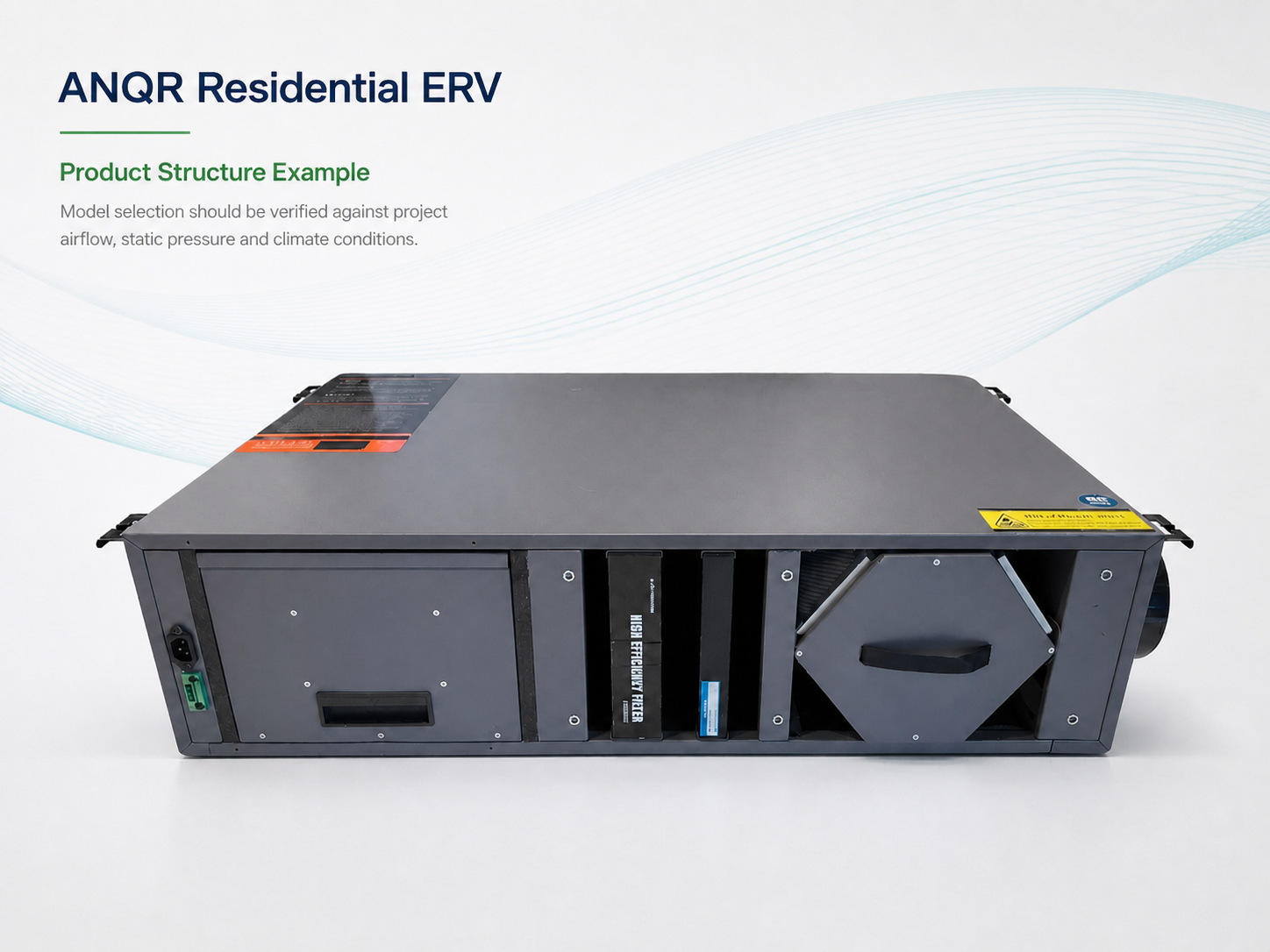 ANQR residential ERV shown as a product-structure example. Final model selection should be verified against project conditions.
Common selection mistakes
- Treating an ERV as a dehumidifier: moisture recovery reduces part of the ventilation load; it does not automatically maintain indoor humidity at a fixed setpoint.
- Choosing from one headline efficiency number: check the test conditions, airflow, fan power, leakage, balance and frost-control performance.
- Ignoring external static pressure: nominal catalogue airflow may not be delivered through the installed duct system.
- Mixing grease exhaust into the recovery system: commercial kitchen grease exhaust is normally handled separately according to local requirements.
- Skipping commissioning: even a correctly selected unit can underperform if supply and exhaust airflows are not measured and balanced.
A practical specification checklist
A useful technical recommendation starts with complete project information. Before final selection, send the manufacturer or supplier:
- Project country, city and outdoor summer and winter design conditions
- Building type, floor area, occupancy schedule and moisture sources
- Required outdoor airflow and applicable ventilation standard
- Indoor temperature and relative-humidity targets
- Installation space, duct layout and estimated external static pressure
- Filter, sound, voltage, frequency and control/BMS requirements
- Frost protection, bypass, drainage or dedicated dehumidification requirements
- Required certification and independent test-report scope
Frequently asked questions
Does an ERV dehumidify a building?
Not by itself. An ERV can transfer part of the incoming moisture load to the outgoing airstream, but indoor humidity control may still require cooling or dedicated dehumidification.
Is an HRV always better in a cold climate?
No. An HRV may be useful when indoor moisture is high, while an ERV can help avoid excessive winter dryness. Climate, occupancy, envelope and frost strategy all matter.
How should airflow be sized?
Use the applicable ventilation standard and project calculations. Check delivered airflow at the actual external static pressure, not only a nominal catalogue value.
What performance data should buyers compare?
Compare airflow, external static pressure, recovery efficiency at stated conditions, fan power, leakage, sound, filtration, frost control, controls and the scope of independent certification.
Which is safer for a mixed climate?
An ERV is often a useful starting point because it transfers both sensible and latent energy, but a psychrometric load check should confirm the final choice.
Explore Related Ventilation Systems
Need help selecting an ERV or HRV for your climate and project? Contact DECETOMair with the project location, application, required airflow and installation type.
Technical references