Pet Room Ventilation and Odor Control Planning
News |
10/20/2026 11:36:18 AM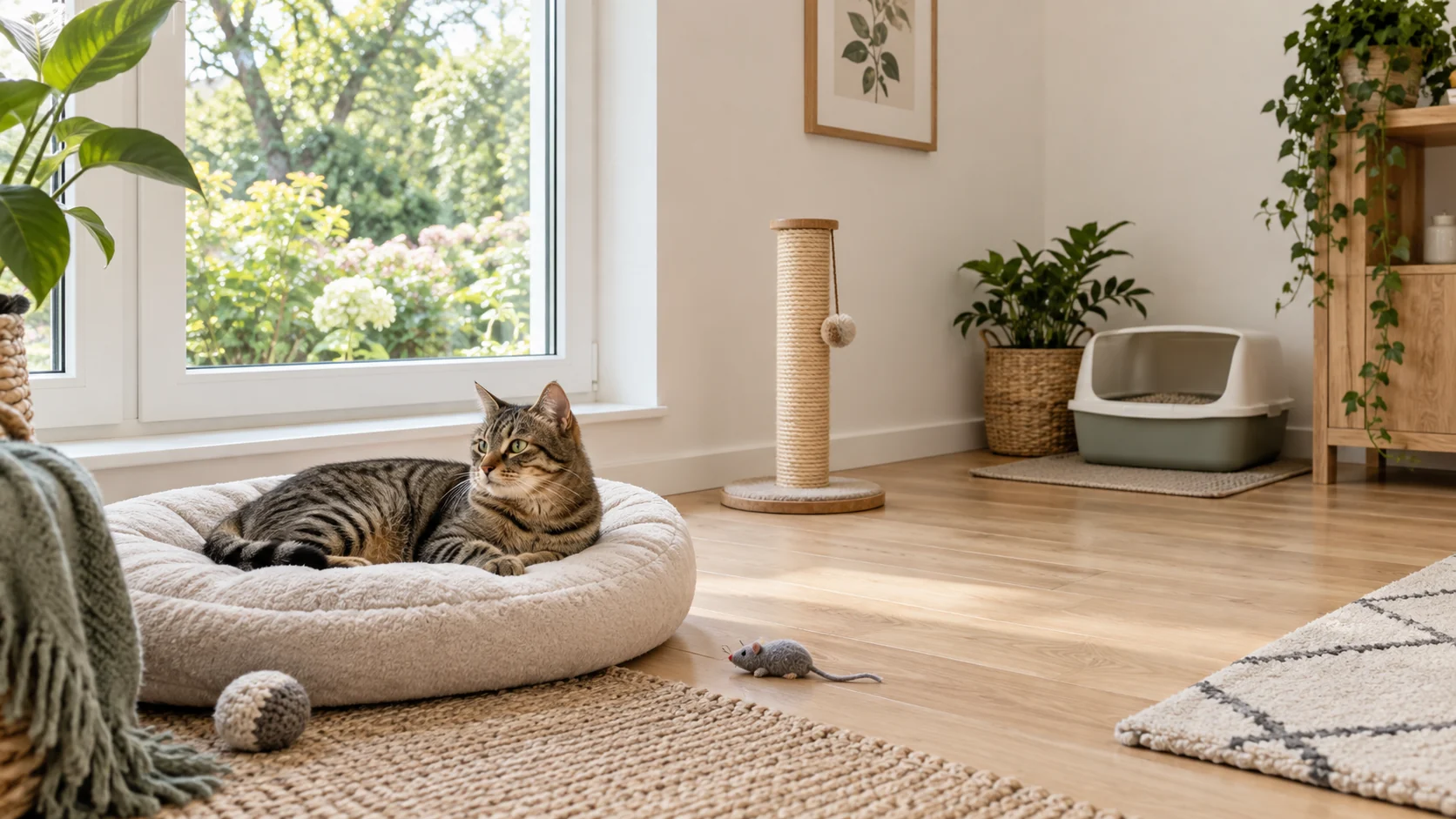 AI-generated concept scene illustrating the article topic, not a documented installation or performance result.
Pet room ventilation should address outdoor-air exchange alongside cleaning and appropriate filtration.
Ventilation can help replace air in a home room shared with pets, but it cannot replace litter care, cleaning or suitable particle filtration. A single room heat recovery ventilator such as the DECETOMair ABT701 series through-wall HRV may be considered for a domestic pet room with an exterior wall when the required airflow and installation conditions are met. It should not be presented as a guaranteed odor remover, a pet-allergy treatment or a complete commercial kennel ventilation system.
When planning litter box ventilation or ventilation for cats, first identify the source location and the air path through the room. A domestic room ventilator is not a dedicated litter enclosure extraction system, and an alternating unit should not be assumed to keep litter odors continuously isolated from adjacent rooms.
Pet room air quality starts with the source
A room used by a cat or dog may need several different actions. Litter, bedding, damp surfaces and stored supplies need source management. Airborne particles need an appropriate particle-control strategy. Air exchange needs a reliable outdoor-air path. These tasks overlap, but they are not interchangeable.
EPA explains that filtration supplements source control and ventilation and that air cleaners do not remove all pollutants [1]. For a pet room, that means cleaning and airflow design remain necessary even if a separate air cleaner is already running. A fan that simply circulates air in the room should not be counted as an outdoor-air supply.
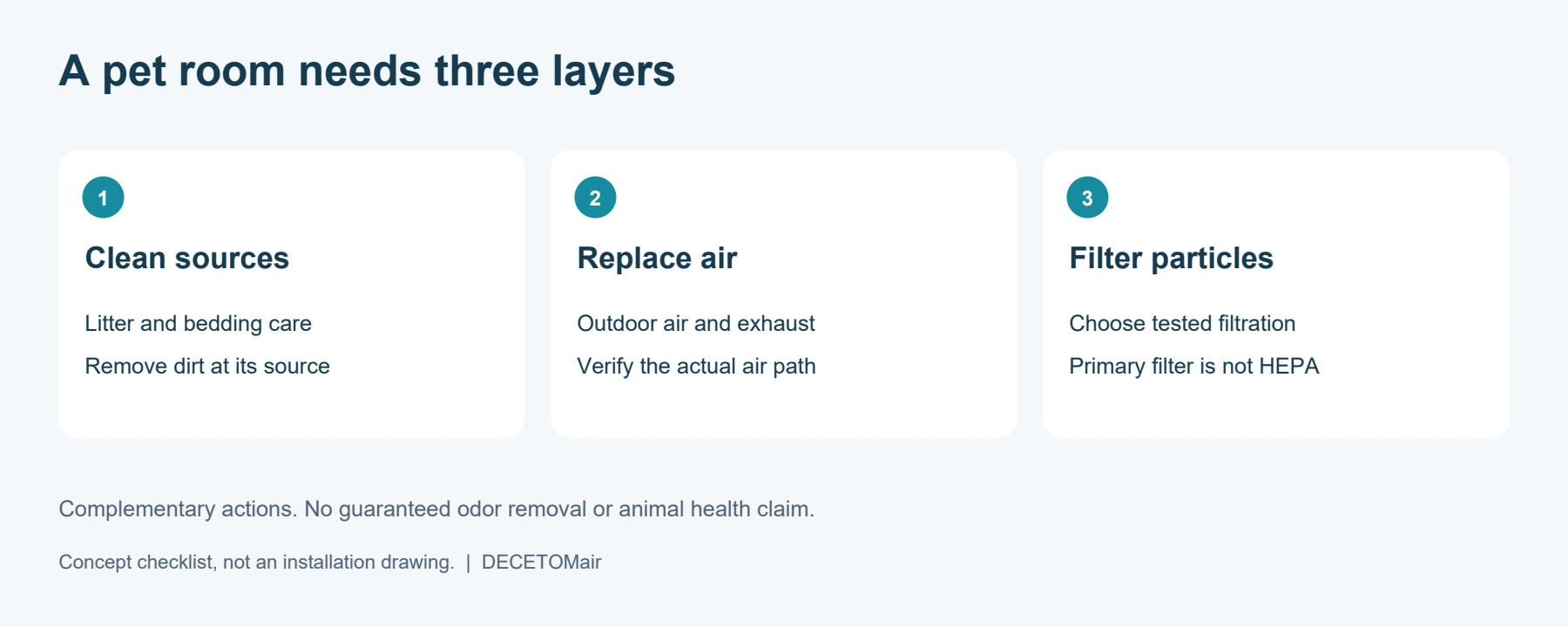 Concept checklist for source cleaning, ventilation and particle filtration; not an installation drawing.
Where a single room HRV may fit
An ABT701-type installation can be evaluated in a home pet room, a room shared by people and pets or a small domestic room being renovated. Its practical attraction is the local through-wall connection rather than a large indoor duct network. A technician still needs to inspect the proposed opening, outdoor intake surroundings and the path of air within the room.
Do not extend a domestic room example to a boarding kennel, grooming wash area, isolation room or veterinary treatment space. Those uses can require defined pressure relationships, extract arrangements, cleaning compatibility and design criteria that a domestic alternating ventilator has not been shown to meet. Commercial suitability needs its own engineering assessment.
Understand the ABT701 airflow cycle
The ABT701 series uses a ceramic core and alternating extraction and supply for heat recovery. Indoor air transfers heat to the core during extraction, and incoming outdoor air receives stored heat during supply. Because one unit changes direction, it does not create a continuously negative-pressure pet room by itself.
The manufacturer's August 2026 sheet lists 50 m3/h for ABT701 and ABT701-WF [3]. Ask the manufacturer to clarify whether that figure represents one-direction airflow or a defined cycle-average value before using it as a continuous outdoor-air supply rate. Confirm the actual cycle, speed and effective delivery, then compare them with the room's ventilation design target. There is no defensible rule that one unit serves a fixed number of pets regardless of room conditions.
Locate the terminals with the animals in mind
Keep the indoor airflow path clear of beds, cages, curtains and stored items. Avoid a concentrated draft at an animal's resting place. Protect electrical cables from chewing and leave maintenance components accessible to an adult. The installer should also consider how furniture or enclosure changes could block the terminal later.
The outdoor connection should be located away from exhaust outlets and other contamination sources, using the required local separations. Do not place the unit where litter dust, wash spray or aggressive cleaning chemicals are likely to enter it. The current manual must govern the permitted installation environment.
Pet odor control and the limits of sensing
ABT701-WF lists VOC and humidity sensing plus app control. This is not evidence that it measures ammonia specifically, counts pet allergens or guarantees an odor-free room. The basic ABT701 should not inherit the WF control features in a distributor's description.
The reviewed standard filter is a primary filter, not a documented HEPA stage. If finer particle capture is required, evaluate a separate product with suitable test evidence. No sterilization or ionization claim is needed to explain this ventilation application. EPA advises against ozone generators in occupied spaces; a ventilation proposal should not add an unverified ozone-based odor treatment [2].
Inspect before airflow declines
Pet hair and visible dust make access and inspection especially important. Inspect the inlet and filter more frequently at first, record what accumulates and adjust the service interval to the observed loading while following the current manual. Check that cleaned parts are suitable for washing before using water and keep electrical parts dry.
After installation, compare the intended and actual operating speed, listen at the resting area and inspect the outdoor terminal. Confirm that closing the room door has not created an unintended airflow problem. If odor persists, reassess sources and the ventilation design rather than relying on fragrance or a higher fan setting alone.
Frequently asked questions
Is a pet air purifier the same as ventilation
A pet air purifier usually filters recirculated room air, while ventilation introduces outdoor air and provides an exhaust path. Check the actual device specification; a primary-filter room HRV is not equivalent to a tested HEPA air cleaner.
Will an ABT701 remove litter odor completely
There is no reviewed model-specific test establishing complete litter-odor removal. Ventilation can contribute to air replacement, while source cleaning and the actual air path determine much of the result.
Can it replace a HEPA air purifier
No. The documented primary filter does not establish equivalent particle capture. Outdoor-air ventilation and particle filtration perform different jobs.
Is the WF humidity sensor a pet safety sensor
No. The listed sensor supports ventilation control; it is not a validated animal-health or hazardous-gas alarm.
For room-level retrofit checks, see our home heat-recovery ventilation guide. For a broader residential calculation, use the ERV and HRV sizing guide; confirm the operating airflow before selecting equipment.
Request a room assessment
Send DECETOMair your room requirements: a room plan, ceiling height, pet-room use, cleaning routine, occupancy schedule and photographs of the proposed exterior wall. For boarding, grooming or clinical facilities, also provide the professional ventilation requirements before selecting equipment.
Sources
[1] US EPA Air Cleaners and Air Filters in the Home. Source
[2] US EPA Ozone Generators that are Sold as Air Cleaners. Source
[3] DECETOMair ABT701 series published product parameters, checked 18 October 2026. Confirm the current model configuration and installation manual for the project.